
How Pressure Decay Testing Ensures Fire Extinguishers Are Ready When Needed
Fire extinguishers are one of the most important safety devices in any facility. However, their reliability depends entirely on whether they can maintain the correct internal pressure. If an extinguisher slowly loses pressure due to leaks or internal failure, it may not function properly in an emergency.
For companies responsible for servicing and certifying fire extinguishers, accurate testing is critical. One of the most effective ways to verify extinguisher integrity is through pressure decay testing.
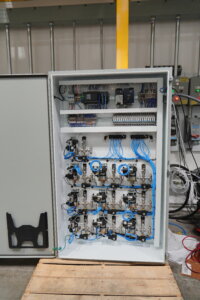
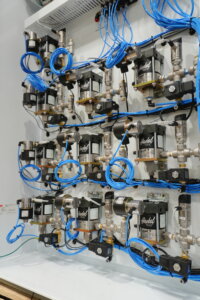
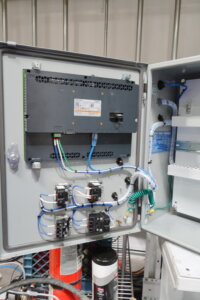
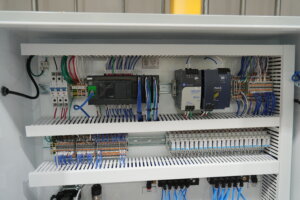
At Coast Pneumatics, we recently engineered a custom pneumatic control panel designed for a fire extinguisher testing system that performs pressure decay testing at 1,000 PSI. This system helps ensure extinguishers maintain the pressure required to operate correctly when they are needed most.
What Is Pressure Decay Testing?
Pressure decay testing is a method used to detect leaks or structural weaknesses in pressurized systems. In this process, a component is pressurized to a specified level and monitored over time to determine whether pressure drops beyond an acceptable limit.
For fire extinguishers, this type of testing is extremely effective because it can detect:
- Micro leaks in seals or valves
- Structural weaknesses in the cylinder
- Improperly sealed components
- Internal failures that could lead to pressure loss
If the extinguisher cannot maintain pressure during the test, it may fail to operate correctly during an emergency.
Why 1,000 PSI Testing Matters
Fire extinguishers operate under high pressure to ensure proper discharge of the extinguishing agent. Because of this, testing systems must be capable of safely handling high-pressure conditions while maintaining precise measurement accuracy.
The custom system engineered by Coast Pneumatics was designed to pressurize extinguishers up to 1,000 PSI and monitor pressure decay over time. This level of testing provides a reliable way to identify potential failures before extinguishers are placed back into service.
High-pressure testing like this requires careful system design, including:
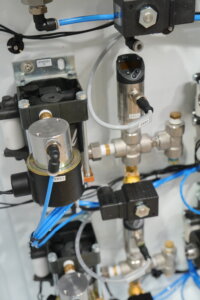
- High-pressure rated pneumatic components
- Precision pressure monitoring
- Controlled pressurization cycles
- Safe system operation for technicians
The Role of Custom Pneumatic Control Panels
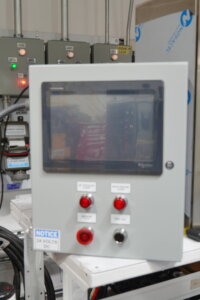
Testing applications like this often require custom-built control panels that integrate pneumatic components, instrumentation, and system controls into a single reliable platform.
For this project, Coast Pneumatics designed a control panel that enables operators to perform consistent and repeatable pressure tests while maintaining safety and reliability.
The system was engineered to provide:
- Controlled pressurization up to 1,000 PSI
- Accurate monitoring for pressure decay detection
- Consistent test cycles for reliable results
- A compact and organized panel layout for easy operation and maintenance
By combining precision pneumatics with thoughtful control design, the system allows technicians to efficiently evaluate large numbers of extinguishers while maintaining testing accuracy.
Improving Safety and Testing Efficiency
Manual inspection methods can sometimes miss subtle leaks or internal failures. Automated or semi-automated pressure decay testing provides a much more reliable method for verifying extinguisher performance.
Benefits of automated testing systems include:
- More accurate leak detection
- Repeatable testing procedures
- Faster inspection throughput
- Improved safety and compliance
For companies responsible for fire extinguisher servicing, these systems can significantly improve both quality control and operational efficiency.
Custom Pneumatic Engineering for Specialized Applications
Many industrial testing systems require custom engineering to meet specific operational requirements. From pressure testing and leak detection to automated actuation and process control, pneumatic systems remain a powerful solution for many specialized applications.
At Coast Pneumatics, our engineering team works with customers to design custom pneumatic systems, control panels, and automation solutions tailored to their exact needs.
Whether the application involves testing, manufacturing, or process automation, the right system design can improve reliability, efficiency, and safety.
Need a Custom Pneumatic Solution?
If your operation requires custom pneumatic engineering, pressure testing systems, or specialized control panels, Coast Pneumatics can help.
Our team designs and builds solutions for a wide range of industrial applications.
Coast Pneumatics
www.coastpneumatics.com
(888) 918-8432