
Coast Pneumatics offers a wide range of individual pneumatic components that require assessment as part of a system. Unlike electrical components that are certified, the functional safety of a specific pneumatic application typically involves utilizing common hardware components. Machine manufacturers are responsible for evaluating and documenting the safety aspects of their systems.
Safety-related pneumatics are complex, which is why our products come with all relevant data as standard. Our project engineers are available to provide expert advice and guide you through processes like Failure Mode and Effects Analysis to ensure your system meets safety requirements efficiently and cost-effectively.
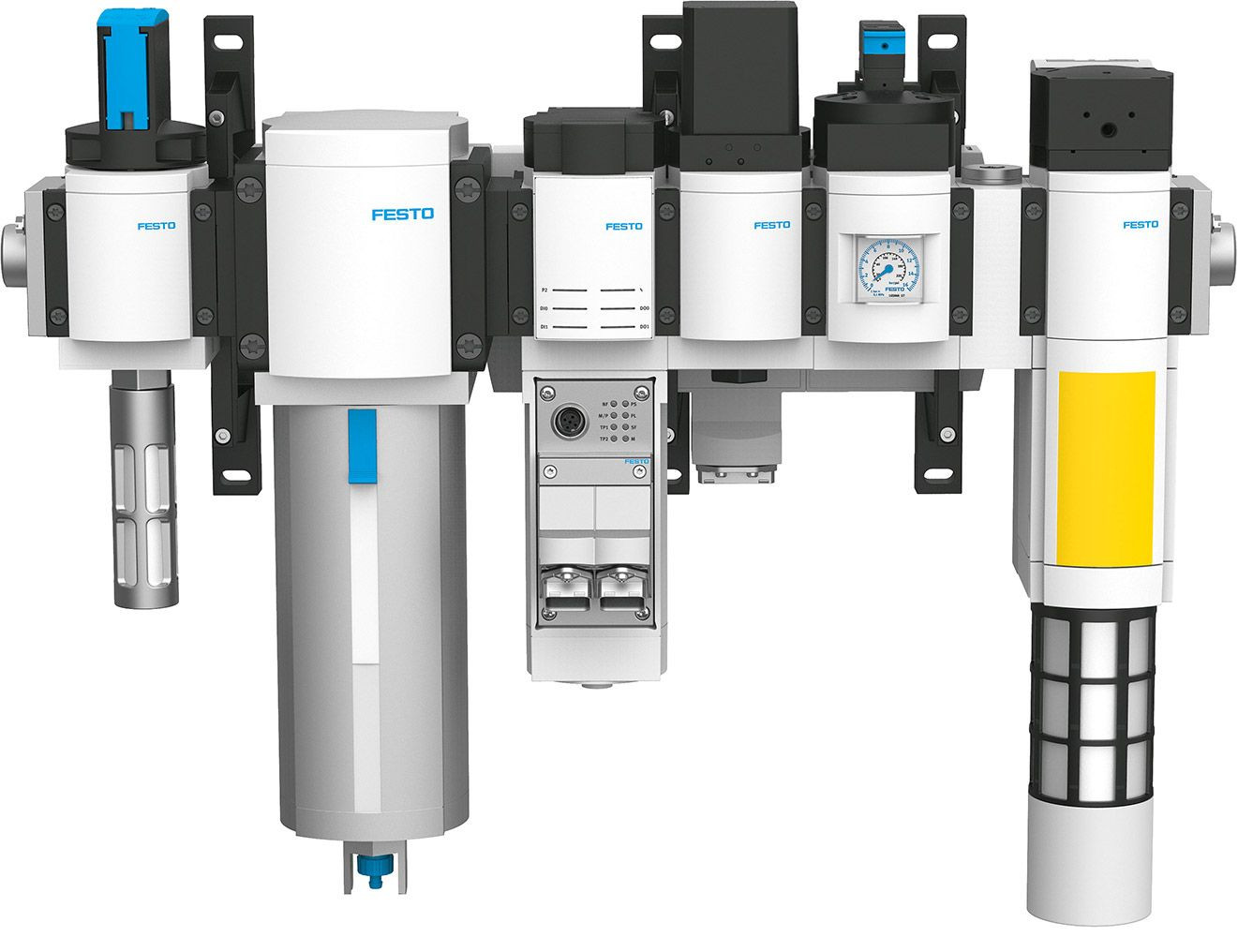
Manual on/off valve
Application:
Manually disconnecting and exhausting the compressed air supply.
Compressed air filter with water/oil separating function
Applications:
Removing particles, oil, and water from the compressed air
Pressure regulation
Application:
Regulating specified operating pressure
Pressure measurement / flow rate / pressure indicator
Application:
Monitoring and detecting critical limit violations
Pressurization
Application:
Controlled gradual pressurization

Safe inputs
Application:
4 safe inputs for integrating sensors with OSSD signal or potential-free contact. Easy configuration of operating modes.
Compressed air filter with water/oil separating function
Applications:
Safe switch-off of the supply voltage to the valves. There are also 2 safe external outputs that are ideal for safely connecting external devices such as valves or further valve terminals. With this module, valves that are located on and connected to the valve terminal are not negatively affected by the test pulses. This allows the service life to be extended and prevents switching of the valves caused by test pulses.
5/2 and 3/2-way valves monostable
Application:
If the valves are switched to the normal position (off) they can then implement one or more safety sub-functions.
5/2 way valves bistable
Application:
The double solenoid valves remain in the switching position last occupied when switched off. However, when the connected drive is or continues to be supplied with working air and is pressurized, a workpiece can be clamped or the position can be maintained.
5/3-way valves monostable
Application:
If the valves are switched to the mid-position (off), they can then implement one or more safety sub-functions
Application
Application:
The exhaust air flow rate can be regulated using a fixed flow restrictor in order to limit the drive speed.

Safe Inputs
Application:
4 safe inputs for integrating sensors with OSSD signal or potential-free contact.
Safe Outputs
Safe switch-off category 3, PL e/ SIL3
Soft start/quick exhaust valve
Application:
The pressure zone is gradually built up to position the valves and drives correctly and then exhausted according to the safety sub-function SDE. This process switches the drives to an unpowered state based on the valve type, preventing unexpected start-ups.
Pilot air switching valve
Application:
If the pilot air switching valve is switched to the normal position (switched off) with the help of the safe electrical zone, the piloted double solenoid valves remain in their current position. Meanwhile, the piloted single solenoid valves switch to the normal position and stay there.
5/2-way valves bistable
Application:
The double solenoid valves remain in the switching position last occupied when switched off. However, when the connected drive is supplied with working air and is pressurized, a workpiece can be clamped or the position can be maintained.
Control block with safety function
Application:
To implement a safe reversing movement of a drive or a system part with a high degree of reliability. This is particularly interesting for press applications.
5/2 and 3/2-way valves monostable
Application:
if the valves are switched to the normal position (switched off), they can then implement one or more safety sub-functions.
Valves with switching position sensing
Application:
By sensing the switching position, the normal position is monitored, thus enabling a high diagnostic coverage.
Vertical stacking
Application:
Other functional units can be added to the valve by using vertical stacking plates. Among other things, this makes it possible to combine pressure regulation, pressure blocking and flow rate throttling functions with the valve function.
5/3-way valves monostable
Application:
IF the valves are switched to the mid position (off), they can then implement one or more safety sub-functions